

Singapore Macro-Feng Shui Analysis: The Qian Sector & Land Exhumations
Updated: Sep 1
Introduction: Is Singapore's National Feng Shui Changing?
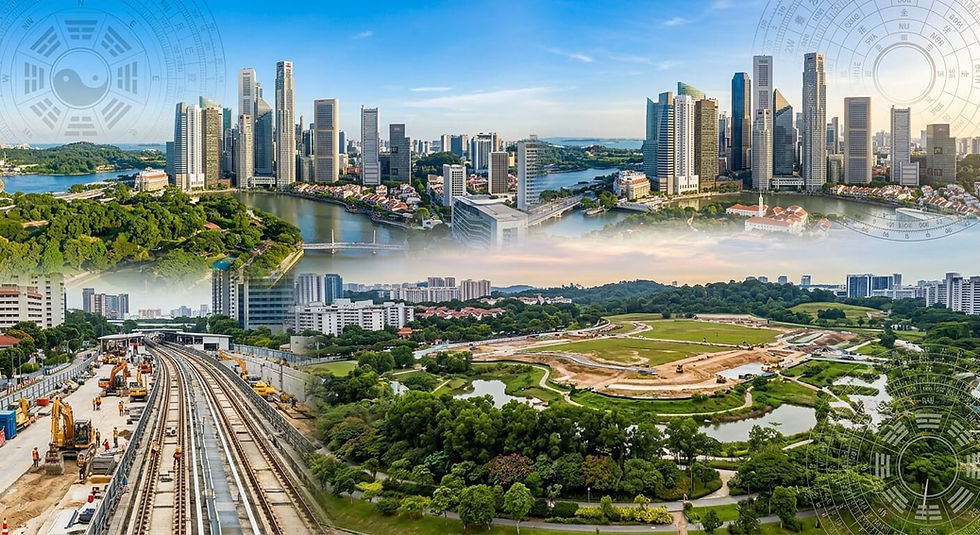
In classical Xuan Kong Feng Shui, a nation's stability and prosperity are never viewed as entirely accidental. They are traditionally understood to be deeply connected to the macro-geomancy of its landscape.
Over the decades, Singapore has earned a global reputation for strong institutional stability, consistent governance and efficient public administration.
However, when we look closely at the five-year period between 2020 and 2025, an unusual cluster of leadership transitions, institutional governance changes and administrative shifts becomes noticeable.
From a metaphysical perspective, these concurrent developments raise a fascinating question:
Could large-scale urban development and structural changes to the earth be interacting with Singapore's national Qi?
This article explores that question through the lens of Macro Feng Shui, Qian sector Feng Shui, landform, Yin Qi and the changing landscape of Singapore's Northwest.
The Significance of the Qian (Northwest) Sector in National Feng Shui

In the I Ching and traditional Chinese geomancy, the Qian (乾) Trigram represents the Northwest direction.
Qian is traditionally associated with:
Metal
Heaven
Authority
Leadership
Senior figures
Government institutions
Power and governance
In a national Feng Shui analysis, the Qian sector can therefore be viewed as particularly significant because of its traditional relationship with authority and leadership.
When the Qian sector of a country is stable, clear and harmonious, traditional Feng Shui theory associates it with stronger administrative continuity and institutional stability.
Conversely, if the Northwest sector experiences significant physical disturbances, environmental changes or major structural alterations, classical geomancy may interpret these changes as potentially reflecting a period of adjustment within the country's broader Qi.
This is a traditional metaphysical interpretation rather than a scientifically established causal relationship.
Singapore's 30–50 Year Period of Stability

If we analyse Singapore's modern history through a metaphysical lens, a striking pattern emerges.
For approximately 30 to 50 years following independence, Singapore experienced an extraordinary period of structural and institutional stability.
During this period, Singapore transformed from a developing nation into a major global economic and financial centre.
While urban redevelopment and infrastructure expansion naturally occurred during these decades, many areas of land remained relatively undisturbed compared with the scale of modern redevelopment.
From a traditional Macro Feng Shui perspective, one could interpret this long period as a time when the nation's macro-Qi remained relatively stable and concentrated.
The question then becomes:
What happens when the physical landscape begins to experience much larger and deeper changes?
The Recent Five-Year Shift: 2020–2025
The period between 2020 and 2025 represents an interesting transition.
During these five years, Singapore experienced significant changes involving:
National leadership
Senior government appointments
Institutional structures
Administrative responsibilities
Major infrastructure development
Large-scale land transformation
From a conventional perspective, these developments can be explained by normal political, social and economic processes.
However, from a Feng Shui Singapore perspective, the clustering of these changes invites another question:
Could changes in the physical environment and changes in national governance be viewed as parallel developments?
This does not mean that Feng Shui can scientifically prove that one caused the other.
Instead, it provides a traditional framework through which the timing of environmental and human changes can be compared.
Macro Disturbances in Singapore's Northwest

The correlation becomes particularly interesting when we examine the physical landscape of Singapore's Northwest.
Large-scale burial management has taken place in Singapore for many years.
However, significant changes to the Choa Chu Kang and Lim Chu Kang cemetery areas have become increasingly prominent in recent years.
These areas are located within Singapore's broader Northwest region, making them particularly interesting from the perspective of Qian sector Feng Shui.
From a conventional land-use perspective, the changes are associated with Singapore's infrastructure and development requirements.
From a traditional geomancy perspective, however, the physical transformation of a long-established landscape raises additional questions about landform, Yin Qi and national Qi.
Lim Chu Kang and Choa Chu Kang Cemetery Exhumations

One of the most significant examples is the large-scale exhumation of graves in the Choa Chu Kang Cemetery area.
Singapore's National Environment Agency has carried out cemetery exhumation programmes in phases. Current programmes include areas of the Chinese and Muslim cemeteries in Choa Chu Kang.
Some of these programmes are connected with major infrastructure and land-use requirements.
The physical process involves much more than simply relocating graves.
Large areas of land may undergo:
Excavation
Earth movement
Heavy machinery operations
Road changes
Land clearance
Terrain modification
Subsequent redevelopment
From a traditional Feng Shui landform perspective, these are substantial environmental changes.
Why Does Deep-Earth Excavation Matter in Feng Shui?

In traditional Chinese geomancy, land is not simply viewed as an empty physical surface.
The concept of Qi extends into the relationship between the landscape, earth, mountains, water and human activity.
Burial sites are also traditionally associated with Yin Qi and ancestral relationships.
Therefore, when large areas of established burial land are excavated and transformed, traditional Feng Shui practitioners may regard the process as a significant disturbance to the existing landscape configuration.
The greater the scale of excavation, the more interesting the question becomes from a Macro Feng Shui perspective.
The issue is not simply that "earth has been moved."
Rather, the question is:
What happens to the traditional energetic relationship between the land, the burial environment and the surrounding landscape after generations of continuity are interrupted?
The Northwest Qian Sector and Singapore's National Qi

The most interesting aspect of this discussion is the location.
The Choa Chu Kang and Lim Chu Kang area sits within Singapore's broader Northwest landscape.
In traditional Feng Shui, the Northwest corresponds to Qian (乾).
Qian represents Heaven and is traditionally associated with:
Authority + Leadership + Senior Figures + Governance
Therefore, from a metaphysical perspective, a major transformation occurring within the Northwest can be examined alongside significant changes in Singapore's leadership and administrative environment.
This is where Macro Feng Shui becomes different from ordinary residential Feng Shui.
Instead of asking:
"Where should I place my bed?"
the question becomes:
"How does a major transformation of the national landscape influence the traditional interpretation of Singapore's Qi?"
The Timeline: Land Changes and Leadership Transitions
One of the most interesting aspects of this subject is the timing.
The physical transformation of the Choa Chu Kang and Lim Chu Kang landscape has developed over multiple years.
At the same time, Singapore experienced significant leadership and institutional changes during the period from 2020 to 2025.
This creates a fascinating timeline for Macro Feng Shui analysis.
From a traditional perspective, researchers may compare:

The purpose is not to claim a simple cause-and-effect relationship.
Instead, the objective is to examine whether the timing and location create a meaningful pattern within traditional Chinese metaphysics.
Is This a Coincidence or a Macro Feng Shui Pattern?
This is perhaps the most fascinating question.
Is the concentration of institutional changes between 2020 and 2025 simply a result of normal political and social development?
Or could traditional geomancy offer another way of interpreting the timing?
Classical Feng Shui does not necessarily require us to choose one explanation.
A metaphysical analysis can examine the physical landscape and historical timeline while acknowledging that political, economic and social factors also play major roles.
Therefore, the question remains open for interpretation:
Is Singapore's Macro Feng Shui shifting as its physical landscape undergoes increasingly significant transformation?
Yin Qi and the Importance of Transition Rituals
Traditional Chinese culture has historically placed importance on respectful treatment of ancestral burial sites.
When graves need to be relocated, traditional practices may include ceremonies and rituals intended to provide respectful closure and transition.
From a metaphysical perspective, these practices are understood as ways of peacefully managing the transition of Yin Qi.
The purpose is not simply ritual for ritual's sake.
It reflects a deeper traditional belief that the relationship between:
Ancestors + Land + Living Environment
should be handled with respect.
Restoring Balance Through Respectful Transition
Whether these simultaneous timelines are viewed as cosmic coincidence, historical development or a reflection of traditional geomancy, Chinese metaphysical traditions emphasise the importance of maintaining harmony during major environmental changes.
When ancestral burial sites are relocated, traditional practices may focus on:
Respect
Proper ceremony
Peaceful transition
Appropriate relocation
Respect for the land
Maintaining harmony between Yin and Yang
From the perspective of traditional Feng Shui, such practices can symbolically support the restoration of balance after major land transformation.
This is particularly relevant when the affected landscape occupies a significant directional sector such as the Qian Northwest sector.
Moving Forward with Harmony
Singapore will continue to develop.
Infrastructure must expand.
Land must be used efficiently.
New transportation networks, housing projects and national facilities will continue to reshape the physical environment.
From a traditional Feng Shui perspective, modern development does not necessarily have to conflict with ancient principles.
The challenge is finding a balance between:
Modern Development + Land + Heritage + Environmental Harmony
Understanding the spiritual and cultural significance traditionally associated with the land does not necessarily mean rejecting modern development.
Instead, it can encourage greater awareness of the historical and cultural layers that exist beneath Singapore's rapidly changing urban landscape.
The Bigger Picture: Singapore's National Feng Shui

The study of Singapore Feng Shui goes far beyond individual homes and offices.
At the national level, Macro Feng Shui considers:
Direction
Landform
Water
Mountains and elevated land
Infrastructure
Urban development
Burial landscapes
Qi
Time
Human activity
The Qian sector is particularly important because of its traditional relationship with Heaven, authority and leadership.
The transformation of Singapore's Northwest landscape therefore provides an intriguing case study for anyone interested in Macro Feng Shui and national Qi.
Conclusion
The question of whether Singapore's Macro Feng Shui is shifting cannot be answered through conventional political or scientific analysis alone.
From a traditional Chinese geomancy perspective, however, the combination of:
Qian Northwest sector
Large-scale land transformation
Choa Chu Kang and Lim Chu Kang exhumations
Changes to the physical landscape
Yin Qi
2020–2025 leadership transitions
creates a fascinating subject for further study.
It is important to emphasise that this does not establish that cemetery exhumations caused political or administrative changes.
Rather, the significance lies in the traditional Feng Shui framework that allows us to examine the relationship between:
Heaven — 天Earth — 地Human — 人

As Singapore continues to transform, the deeper question is not simply whether development is good or bad.
It is whether modern development can continue while maintaining harmony with the physical, cultural and traditional heritage of the land.
In the language of classical Feng Shui:
When the land changes, the Qi changes.When the Qi changes, the environment changes.And when the environment changes, human activity may be interpreted through a different energetic landscape.
Whether one views this as metaphysics, cultural tradition or simply an intriguing historical coincidence, Singapore's changing Northwest landscape provides a remarkable case study in Macro Feng Shui, Qian sector analysis and national Qi.


Comments